
We can represent a list of numbers 3,5,2,4,1 visually as follows.我们可以将数字列表 3、5、2、4、1 以如下方式直观地表示出来。
(The smaller red numbers above indicate the positions in the list named 'X.')(上面较小的红色数字表示在名为“X”的列表中的位置。)
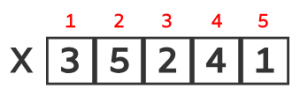
We write (X 2) to describe the number at position 2. So (X 2) is 5. Similarly (X 5) is 1.我们用 (X 2) 来表示位置 2 上的数字。所以 (X 2) 是 5。同样地,(X 5) 是 1。
The positions can be indicated indirectly, for example:这些位置可以间接表明,例如:
(X (X 3)) is 5 because (X 3) is 2, so (X (X 3)) = (X 2) = 5.(X (X 3)) 等于 5,因为 (X 3) 等于 2,所以 (X (X 3)) = (X 2) = 5。
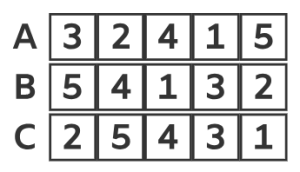
Here are three lists, A, B and C.这里有三个列表,分别是 A、B 和 C。
Question:问题:
What is the number described by (A (B (C 3)))?由 (A (B (C 3))) 描述的数字是多少?
A. 1
B. 2
C. 3
D. 4
E. 5
Explanation 解释
Answer: 答案:
4
Explanation: 解释:
(C 3) = 4, so (B (C 3)) = (B 4) = 3, so (A (B (C 3)) = (A (B 4)) = (A 3) = 4.(C 3) = 4,所以 (B (C 3)) = (B 4) = 3,所以 (A (B (C 3))) = (A (B 4)) = (A 3) = 4。
This can be shown by substituting these values working from the inside out:这可以通过从内向外代入这些值来证明:
(A (B (C 3))) → (A (B (4)))→ (A (3))→ (4)
点击右侧文字,可获得更多在线练习题资源:>>> Bebras在线水平测试
Bebras新赛季备赛已开启,扫码领取Bebras真题资料⇓
欢迎咨询【Bebras专业辅导课程】

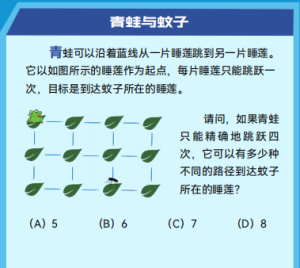
(Bebras每日一练部分展示)